Subdomain enumeration is one of the most important steps in reconnaissance and penetration testing. Security researchers, bug bounty hunters, and cybersecurity professionals rely on specialized tools to discover subdomains associated with a target domain. Two of the most popular tools for this purpose are Sublist3r and Subfinder.
While both tools are designed to find subdomains, they differ significantly in terms of speed, accuracy, data sources, and usability. In this article, we’ll compare Sublist3r and Subfinder in detail to help you choose the right tool for your reconnaissance workflow.
Read More: How Can I Fix Sublist3r Installation Errors?
What is Sublist3r?
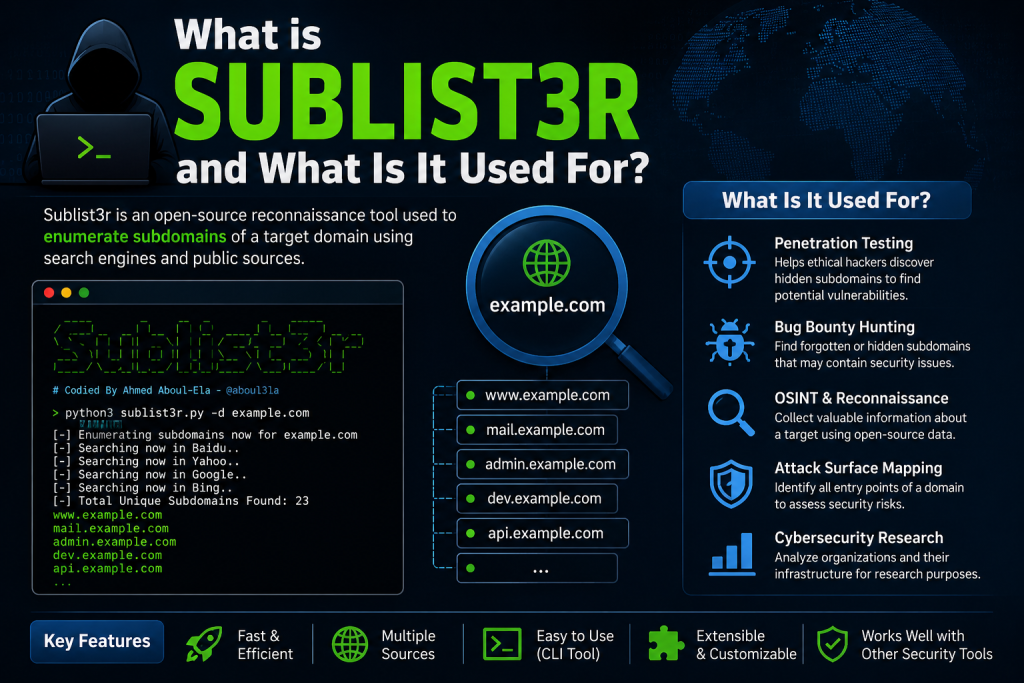
Sublist3r is an open-source Python-based subdomain enumeration tool developed to gather subdomains using various search engines and public sources. It automates the process of discovering subdomains from search engines such as Google, Bing, Yahoo, Baidu, and Ask.
The tool gained popularity among penetration testers because it simplified passive reconnaissance and provided a quick way to identify publicly available subdomains.
Key Features of Sublist3r
- Passive subdomain enumeration
- Uses multiple search engines and public sources
- Open-source and free to use
- Python-based implementation
- Supports brute-force functionality through integration with subbrute
What is Subfinder?
Subfinder is a fast and modern subdomain discovery tool developed by ProjectDiscovery. Unlike Sublist3r, Subfinder focuses heavily on passive enumeration and integrates with numerous APIs and threat intelligence sources.
Written in Go (Golang), Subfinder is optimized for speed and scalability, making it a preferred choice for bug bounty hunters and professional security teams.
Key Features of Subfinder
- High-speed subdomain discovery
- Passive reconnaissance approach
- Supports dozens of data sources and APIs
- Lightweight and efficient
- Easy integration into automation pipelines
- Active development and regular updates
Sublist3r vs Subfinder: Key Differences
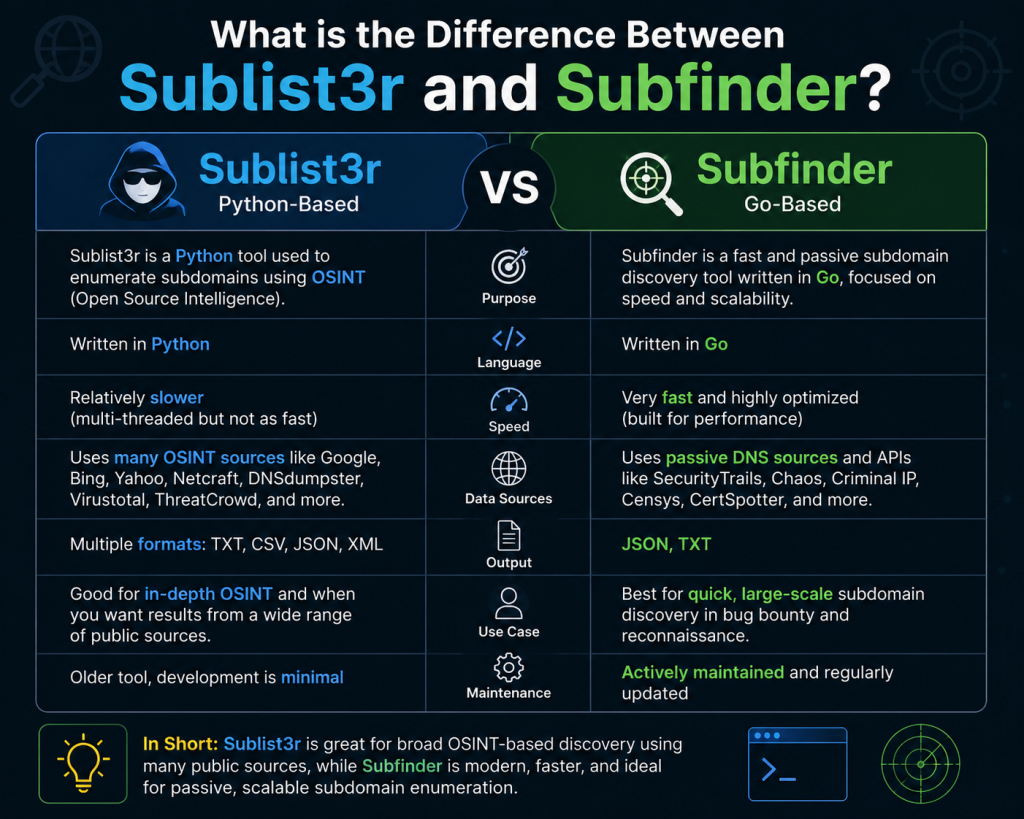
Programming Language
One of the most noticeable differences is the technology stack behind each tool.
Sublist3r
- Built with Python
- Requires Python dependencies
- Generally slower for large-scale scans
Subfinder
- Built with Go
- Compiled binary with minimal dependencies
- Faster execution and better resource management
Winner: Subfinder
The Go-based architecture provides better performance and portability.
Speed and Performance
Speed is critical when conducting reconnaissance on multiple targets.
Sublist3r relies heavily on scraping search engines, which can be slower and sometimes limited by rate restrictions.
Subfinder, on the other hand, uses optimized API integrations and concurrent processing, allowing it to discover subdomains much faster.
Winner: Subfinder
For large-scale reconnaissance projects, Subfinder significantly outperforms Sublist3r.
Data Sources
The quality of subdomain enumeration largely depends on available data sources.
Sublist3r Sources
- Bing
- Yahoo
- Baidu
- Ask
- Netcraft
- Virustotal
- ThreatCrowd
Subfinder Sources
- SecurityTrails
- Shodan
- VirusTotal
- Censys
- Chaos Dataset
- DNSDB
- GitHub
- Passive DNS providers
- Many additional sources
Winner: Subfinder
Subfinder supports a much broader range of intelligence sources, leading to better coverage.
Accuracy and Coverage
Modern reconnaissance requires access to diverse data providers. Since Subfinder integrates with numerous APIs and continuously updated sources, it typically finds more subdomains than Sublist3r.
Sublist3r may still discover useful assets, but its source list is relatively limited compared to today’s standards.
Winner: Subfinder
More sources generally result in better enumeration coverage.
Automation and Integration
Automation is essential for bug bounty hunting and enterprise security operations.
Subfinder is designed with automation in mind and integrates seamlessly with other ProjectDiscovery tools such as:
- Amass
- Httpx
- Naabu
- Nuclei
- Katana
Sublist3r offers basic functionality but lacks modern automation capabilities.
Winner: Subfinder
Its ecosystem support makes it ideal for advanced reconnaissance workflows.
Maintenance and Community Support
Tool maintenance directly impacts reliability and compatibility.
Sublist3r
- Older project
- Less frequent updates
- Limited modernization
Subfinder
- Actively maintained by ProjectDiscovery
- Frequent feature updates
- Strong community adoption
Winner: Subfinder
Active development ensures better performance and support for new data sources.
Feature Comparison Table
| Feature | Sublist3r | Subfinder |
|---|---|---|
| Programming Language | Python | Go |
| Passive Enumeration | Yes | Yes |
| Speed | Moderate | Very Fast |
| API Integrations | Limited | Extensive |
| Automation Support | Basic | Advanced |
| Active Development | Limited | Frequent |
| Scalability | Medium | High |
| Bug Bounty Friendly | Good | Excellent |
When Should You Use Sublist3r?
Sublist3r may still be useful if:
- You are learning subdomain enumeration concepts.
- You need a lightweight Python-based tool.
- You want to compare results from multiple enumeration tools.
- You are working in an environment where legacy workflows already use Sublist3r.
When Should You Use Subfinder?
Subfinder is the better choice if:
- You perform regular bug bounty hunting.
- You need fast reconnaissance results.
- You automate security assessments.
- You conduct large-scale asset discovery.
- You want access to a wider range of passive data sources.
Can You Use Both Together?
Absolutely.
Many experienced security researchers combine multiple reconnaissance tools to maximize coverage. Running both Sublist3r and Subfinder can uncover unique subdomains that one tool alone may miss.
A common workflow is:
- Run Subfinder for extensive passive enumeration.
- Run Sublist3r as an additional source.
- Merge and deduplicate results.
- Validate discovered hosts using HTTP probing and DNS resolution tools.
This approach increases the likelihood of finding hidden or overlooked assets.
Conclusion
When comparing Sublist3r vs Subfinder, Subfinder emerges as the clear winner for most modern reconnaissance tasks. It offers superior speed, broader data source coverage, better automation capabilities, and active development support.
Sublist3r remains a useful educational and supplementary tool, but security professionals and bug bounty hunters generally prefer Subfinder for day-to-day subdomain enumeration.
If your goal is efficient and scalable asset discovery, Subfinder is the recommended choice, while Sublist3r can serve as a valuable secondary tool to enhance coverage.